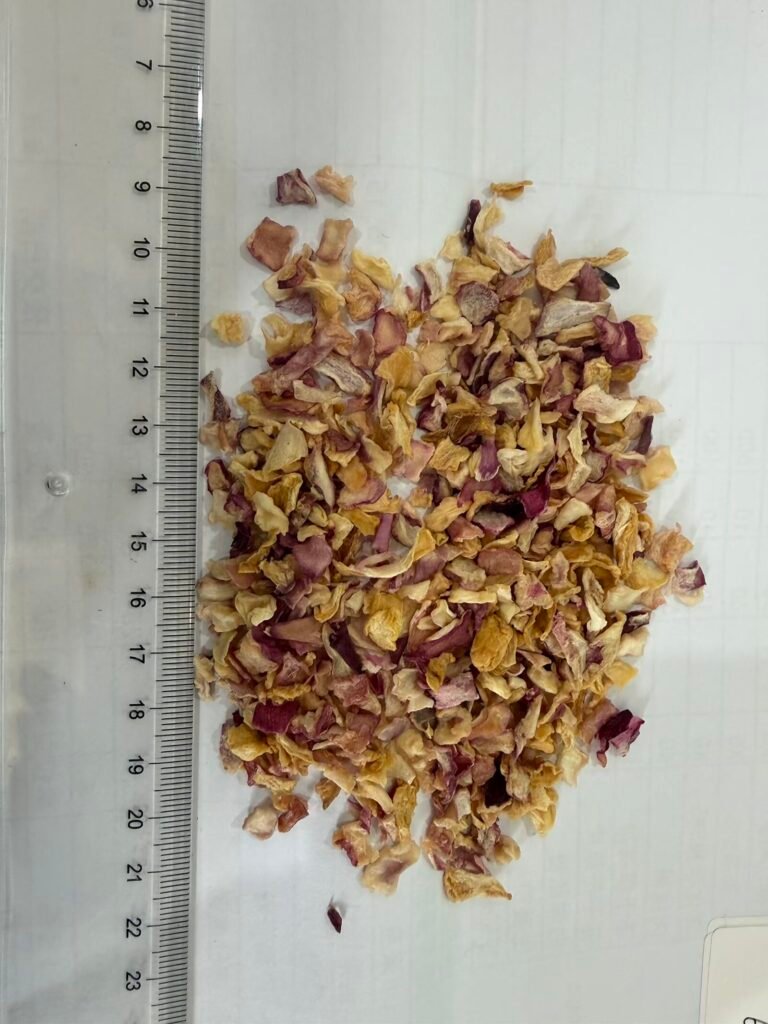
Red shallot is widely used in seasoning blends, sauces, soups, instant foods, meat products and ready-to-eat meals. Its distinctive aroma and mild sweetness can add depth to a food formulation, but the quality of the final product depends heavily on the raw material.
For food manufacturers, evaluating red shallot quality involves more than checking its color or appearance. Flavor consistency, moisture control, microbiological safety, processing specifications and supply stability should all be considered before placing a bulk order.
1. Check the Raw Material Quality
Good processed red shallot begins with suitable fresh shallots. The raw bulbs should be mature, firm and free from serious decay, mold, insect damage or excessive sprouting.
The growing region, harvest season and storage conditions can influence the shallot’s color, aroma and pungency. Buyers should therefore ask suppliers how raw materials are selected and whether they can provide stable sourcing across different production batches.
A reliable supplier should have clear procedures for raw material inspection before the shallots enter production.
2. Evaluate Color and Appearance
Color is one of the first indicators buyers notice. Good-quality red shallot should retain a natural reddish-purple or light purple appearance, depending on the variety and processing method.
For dried red shallot products, excessive browning may indicate unsuitable drying temperatures, prolonged processing or improper storage. Very pale material may suggest inconsistent raw materials or excessive processing.
However, natural color variation can occur between harvests. Instead of judging the product from one sample alone, buyers should establish an acceptable color range and compare samples from multiple batches.
3. Assess Aroma and Flavor
Red shallot should have a recognizable allium aroma with a balanced pungent and slightly sweet flavor. It should not have burnt, musty, sour or stale odors.
The intensity of the aroma may vary according to the shallot variety, cut size and drying method. Smaller pieces or powder generally release flavor more quickly, while larger flakes may provide a slower flavor release during cooking.
Food manufacturers should test the ingredient in their actual formulation rather than relying only on a dry sample. Performance in soup, sauce, seasoning or meat applications may differ from its aroma in the package.
4. Confirm the Cut Size and Uniformity
Red shallot can be supplied in several forms, including whole pieces, slices, flakes, granules and powder. The right format depends on the intended application.
Uniform sizing is important because it affects:
- Mixing consistency
- Rehydration performance
- Flavor release
- Product appearance
- Filling and packaging efficiency
For visible applications such as instant noodles or soup mixes, consistent slices or flakes are usually more important. For seasoning blends, sauces and processed foods, granules or powder may provide better dispersion.
Buyers should confirm the required mesh size, slice thickness or particle range before ordering.
5. Review Moisture and Product Stability
Moisture control directly affects storage stability. If a dried shallot product contains excessive moisture, it may become soft, clump easily or develop quality problems during storage.
The required moisture level should be agreed upon according to the product form and application. Buyers should also check whether the supplier controls drying temperature, final moisture and storage conditions during production.
Packaging must provide suitable protection against humidity, especially when red shallot powder or fine granules are shipped over long distances.
6. Check Purity and Foreign-Material Control
Bulk red shallot ingredients should be clean and free from unacceptable foreign materials. During processing, suppliers should use sorting, screening, magnetic separation or other suitable inspection methods to remove unwanted matter.
Quality evaluation should cover:
- Shallot skin and root residues
- Soil, stones or plant debris
- Metal contamination
- Insect damage
- Burnt or discolored pieces
- Cross-contamination from other products
The acceptable limits should be clearly defined in the purchase specification.
7. Examine Microbiological and Food Safety Controls
Red shallot is a food ingredient, so microbiological control is essential. Buyers should request relevant test information based on their market and application, which may include total plate count, yeast and mold, coliforms, E. coli and Salmonella.
Requirements may differ between countries and product categories. A seasoning manufacturer, ready-meal producer and infant-food processor may apply different standards.
The supplier should operate under a documented food safety management system and provide batch testing or third-party reports when required.
8. Ask About Traceability and Certification
A reliable red shallot supplier should be able to trace products from the finished batch back to the raw material and production records.
Useful supplier information may include:
- Raw material origin
- Production date and batch number
- Processing records
- Quality inspection results
- Allergen-control procedures
- Pesticide-residue testing
- Food safety certifications
- Export documentation
Certifications such as BRC, FSSC 22000, HACCP, ISO, Halal or Kosher may be important depending on the buyer’s market. Certification alone does not guarantee product quality, but it helps demonstrate that the supplier follows structured production and control procedures.
9. Evaluate Packaging and Storage Conditions
Packaging should protect red shallot from moisture, contamination, light and odor transfer. Common industrial packaging may include food-grade inner bags combined with cartons, woven bags or other export packaging.
Before ordering, buyers should confirm:
- Net weight per package
- Inner and outer packaging materials
- Seal integrity
- Label and batch information
- Pallet requirements
- Storage temperature and humidity
- Expected shelf life
Proper packaging is especially important for powdered products, which can absorb moisture and external odors more easily.
10. Test Samples Before Bulk Purchasing
A sample test is one of the most practical ways to evaluate red shallot quality. The sample should be checked not only in the laboratory but also in the intended food formulation.
During testing, buyers can compare:
- Aroma strength
- Flavor balance
- Color contribution
- Rehydration behavior
- Solubility or dispersibility
- Performance during cooking
- Compatibility with other ingredients
After approving a sample, the agreed specifications should be documented and used as the reference for future deliveries.
Choosing a Reliable Red Shallot Supplier
The best red shallot supplier is not simply the one offering the lowest price. Food manufacturers should consider raw material sourcing, processing capability, food safety management, batch consistency, documentation and delivery reliability.
Clear communication is equally important. Buyers should provide the intended application, required product form, cut size, moisture specification, packaging and target market. This allows the supplier to recommend a suitable red shallot ingredient and prepare a more accurate quotation.
By evaluating these factors before purchasing, food processors can reduce quality variation, improve formulation consistency and build a more reliable ingredient supply chain.